





.svg)

.png)

Jarrad Sonnenberg

October 15 2026

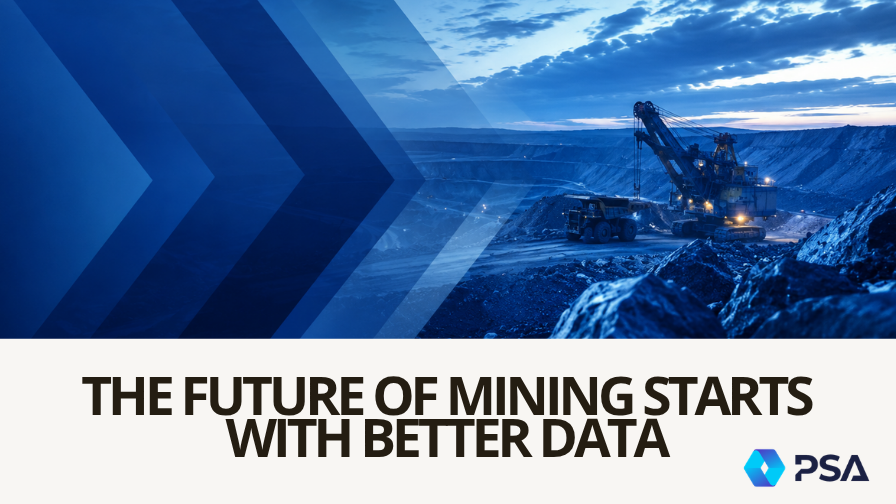
For decades, mining companies have competed by investing in bigger fleets, more efficient processing plants, and new technologies designed to increase production. While those investments remain critical, many operators are beginning to recognize that the next gains in productivity are less likely to come from the equipment itself and more likely to come from the information that surrounds it.
The challenge is not that the mining industry lacks data. In fact, most operations generate enormous volumes of it every day. Fleet management systems capture equipment performance, condition monitoring tools report on asset health, dispatch systems record production activity, finance tracks costs, procurement manages purchasing, and maintenance teams document work orders. The problem is that much of this information exists in isolation.
When critical operational data is spread across multiple systems, decisions become slower, reporting becomes more difficult, and teams spend valuable time validating information rather than acting on it.
As commodity markets remain volatile and operating costs continue to rise, mining companies are placing renewed emphasis on improving operational visibility. The goal is no longer simply collecting more data; it's ensuring that data can be trusted and used to make better business decisions.
The average mine today is significantly more complex than it was even a decade ago. Operations often span multiple sites, supply chains are increasingly global, and equipment has become more sophisticated and expensive to maintain. At the same time, companies face growing pressure to improve ESG performance, reduce costs, maximize asset utilization, and operate with fewer experienced personnel.
These challenges have exposed the limitations of many legacy ERP environments. Systems originally implemented to support finance and procurement are now expected to provide real-time insight into maintenance planning, inventory availability, project costs, contractor management, and production performance. Many simply were never designed for that level of operational integration.
As a result, organizations frequently rely on disconnected software applications or manual processes to bridge the gaps. Maintenance teams may plan shutdowns in Excel, warehouse personnel maintain independent inventory records, and operations managers build reports by combining information from multiple sources before presenting it to leadership.
While these workarounds are common, they also introduce risk. Every duplicate data entry, every manual report, and every disconnected spreadsheet increases the likelihood of errors and reduces confidence in the information being used to make operational decisions.
Mining companies understand the cost of equipment downtime, but many underestimate the financial impact of incomplete or inaccurate asset information.
Consider a scheduled rebuild of a haul truck. If maintenance records are incomplete, procurement cannot accurately forecast replacement parts, inventory cannot verify component availability, and planners may be forced to delay work while waiting for additional information. What appears to be a maintenance issue is often an information issue.
The same challenge exists with rotable assets. Components such as engines, wheel motors, pumps, transmissions, and gearboxes move through repeated cycles of installation, removal, overhaul, storage, and redeployment. Without a system capable of tracking serial numbers, repair history, lifecycle costs, warranty status, and current availability, organizations risk purchasing unnecessary inventory, extending equipment downtime, or missing opportunities to rebuild existing assets more cost effectively.
For many mining companies, rotable management represents one of the greatest opportunities to improve both equipment availability and inventory performance.
Historically, ERP implementations were often viewed as technology initiatives led by finance or IT departments. Today, that perspective is changing.
Mining companies increasingly recognize that ERP decisions influence every operational discipline, from maintenance planning and warehouse operations to procurement, finance, and executive reporting. Successful implementations require input from the people who rely on the system every day, not just those responsible for deploying it. This shift has also changed expectations around implementation partners. Mining organizations are looking for advisors who understand equipment availability, shutdown planning, maintenance workflows, and supply chain challenges, not simply software configuration.
Technology remains important, but operational expertise has become equally valuable.
The mining industry's digital transformation is often discussed in terms of automation, artificial intelligence, and predictive analytics. While those technologies continue to evolve, their success depends on one fundamental requirement: reliable operational data. Artificial intelligence cannot optimize maintenance schedules if asset histories are incomplete. Predictive analytics cannot improve inventory planning if warehouse data is inaccurate. Executive dashboards cannot support strategic decisions if information is being consolidated manually every month.
For that reason, many mining organizations are shifting their focus toward building connected operational environments where maintenance, procurement, inventory, finance, projects, and production all operate from a common source of information. Platforms such as Pronto ERP, combined with operational technologies like Tekton OS, are helping organizations move beyond traditional ERP by connecting field execution with enterprise decision-making. The objective is not simply to digitize existing processes, but to create a more informed operation where decisions can be made with greater confidence and speed. As mining companies continue investing in modernization initiatives, the organizations that gain the greatest competitive advantage will not necessarily be those with the most technology. They will be those with the most reliable information, and the ability to turn that information into better operational decisions.
Mining has always been an industry built on precision. Every tonne moved, every hour of equipment availability, and every operational decision has a measurable impact on performance. As mines become more connected and data becomes increasingly valuable, the ability to turn information into action will define the next generation of operational excellence.
The question is no longer whether mining companies need modern ERP systems. It's whether their current systems are providing the visibility, reliability, and insight required to compete in an increasingly complex industry.
Stay ahead of the curve with real-world insights, tips, and stories from the frontlines of ERP in mining and beyond. Follow us on LinkedIn and join the conversation.
.png)
Just Now
.svg)
Maecenas bibendum rhoncus tellus facilisis. Dui ut risus vel ridiculus arcu cursus. Lectus eget a non nulla Dui ut risus.
.png)
.png)
Just Now
Maecenas bibendum rhoncus tellus facilisis. Dui ut risus vel ridiculus arcu cursus. Lectus eget a non nulla Dui ut risus.
.png)
.png)
Just Now
Maecenas bibendum rhoncus tellus facilisis. Dui ut risus vel ridiculus arcu cursus. Lectus eget a non nulla Dui ut risus.
Just Now
Maecenas bibendum rhoncus tellus facilisis. Dui ut risus vel ridiculus arcu cursus. Lectus eget a non nulla Dui ut risus.
Just Now
Maecenas bibendum rhoncus tellus facilisis. Dui ut risus vel ridiculus arcu cursus. Lectus eget a non nulla Dui ut risus.
Just Now
Maecenas bibendum rhoncus tellus facilisis. Dui ut risus vel ridiculus arcu cursus. Lectus eget a non nulla Dui ut risus.
PSA brings mining fluency, structured implementation, and global capability to ensure your system performs under pressure.
Make the right move. We’re ready when you are.
© 2026 Pronto Solutions Alliance Inc.Privacy Policy


.png)
.png)


.svg)
